
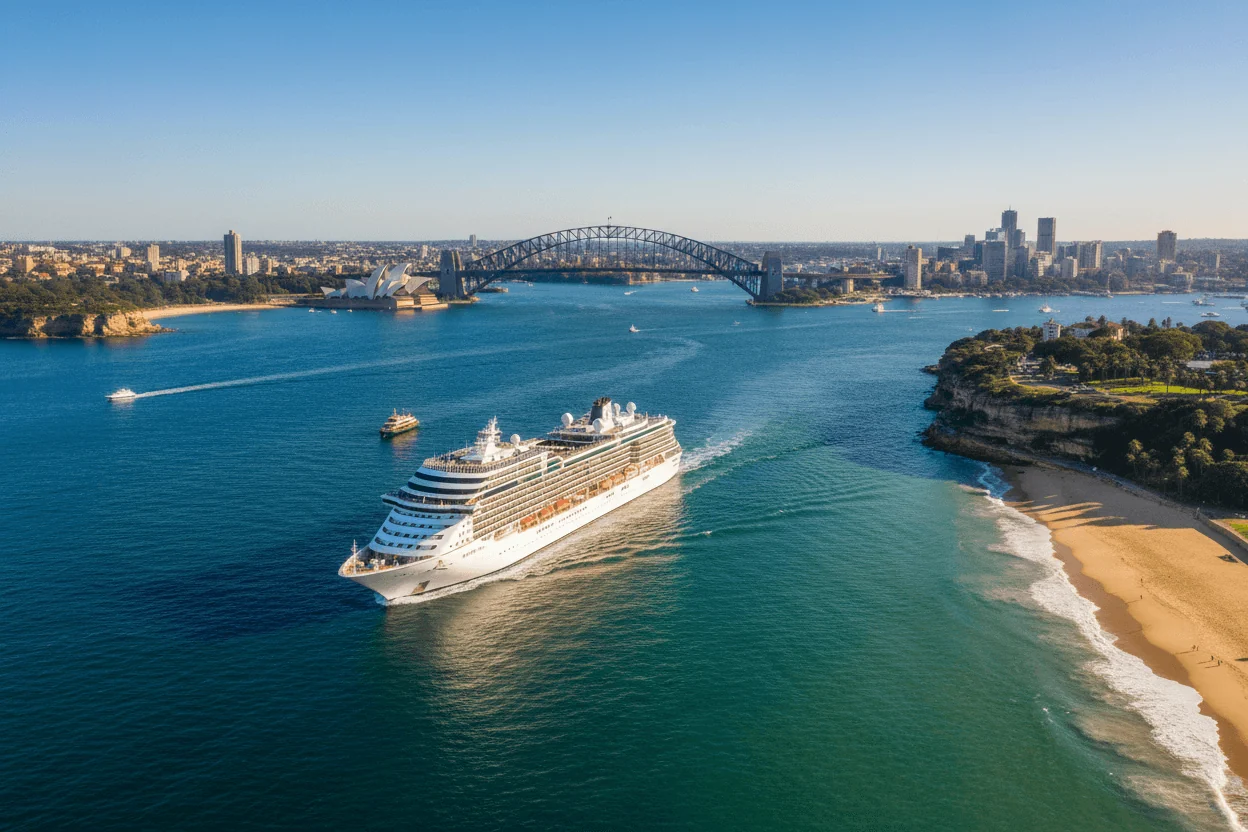

Ask most Australians where they’d go on a cruise and they’ll name somewhere overseas: the South Pacific, Asia, the Mediterranean. Yet some of the most extraordinary sea journeys on the planet start and finish here at home. Australian coastal cruises take in tropical reefs, red-rock wilderness, wind-swept southern islands and one of the world’s great harbours, often without the need for a passport.
The variety is what surprises people. A coastal cruise in the Kimberley has almost nothing in common with one on the Great Barrier Reef, and neither resembles a summer trip along the Southern Ocean coast. Each region has its own season, wildlife, landscapes and style of travel.
This guide breaks down the main regions for an Australian cruise along the coast, the best months to visit each, and what to consider when choosing between them, so you can match the trip to the experience you’re actually after.
Why choose an Australian cruise close to home?
There are good practical reasons to cruise domestically before you even consider the scenery.
Less travel time. Domestic flights are shorter, time zones are manageable and there’s no long-haul recovery. You can be exploring a remote coastline within a day of leaving home.
No currency or visa hassle. For Australian residents, there’s no foreign exchange, no visa paperwork and no language barrier to contend with.
Access to genuine wilderness. A large share of Australia’s coast has no road access. For many of these places, travelling by ship isn’t just the most comfortable option, it’s one of the only ways in.
Seasonal flexibility. Because the country spans tropical and temperate zones, there’s an Australian coastal cruise that suits almost every month of the year. When the north is in its wet season, the south is at its best, and vice versa.
It’s also a way to understand your own country differently. Seeing the coast from the water, rather than from a highway or a plane window, changes your sense of how vast and varied it really is.
The main regions for Australian coastal cruises
The Kimberley
Stretching between Broome and Wyndham in Western Australia, the Kimberley coast is one of the most remote regions on the continent. It’s defined by deep red sandstone cliffs, winding rivers, waterfalls that pour off escarpments and some of the largest tides in the country. Cruises here commonly visit landmarks such as Horizontal Falls in Talbot Bay, Montgomery Reef, the Prince Regent and Hunter rivers and the scattered islands of the Buccaneer Archipelago.
The Kimberley season runs through the dry, roughly April to September. Early season often brings fuller waterfalls after the wet, while later months tend to offer more settled weather.
The Great Barrier Reef
The reef stretches more than 2,300 kilometres along the Queensland coast. A multi-day coastal cruise lets you explore beyond the busy day-trip sites, reaching outer reefs, islands and sand cays over several days. Snorkelling is usually the centrepiece, alongside island walks and time on quiet beaches.
The drier months, roughly June to November, are generally the most comfortable, with lower humidity and fewer marine stingers than the northern summer.
The west coast and the Rowley Shoals
Western Australia’s coast offers some of the clearest water in the country. The Rowley Shoals, a trio of coral atolls roughly 300 kilometres off Broome, are prized by snorkellers and divers. Further south, the Ningaloo region draws visitors for its fringing reef, and the coastline between is wild, empty and spectacular.
The Rowley Shoals have a short season, typically in spring, when sea conditions are calmer.
The southern coast
From the granite islands of the Recherche Archipelago off Esperance to the long, rugged shoreline of South Australia, the south offers cooler-water cruising with a very different feel. Think sea lions, seabirds, towering cliffs, white-sand beaches and bracing coastal walks. Summer is the time to go, when the Southern Ocean is at its most settled.
Sydney and the east coast
Sydney Harbour, Pittwater and the Hawkesbury River suit shorter coastal cruises, particularly in summer and over New Year’s Eve, when the harbour becomes the centre of the country’s celebrations.
For a broader look at how these regions compare in one place, it helps to browse a range of coastal cruises around Australia’s remote shores, noting the season, length and starting port of each itinerary.
Choosing the right Australian cruise season
One of the simplest ways to narrow down your options is to start with when you can travel, then look at where’s at its best during that window.
| Time of year | Regions worth considering |
| December to February | Southern coast, Sydney and the east coast |
| March to May | Early Kimberley season (from around April) |
| June to August | Kimberley, Great Barrier Reef |
| September to November | Late Kimberley season, Great Barrier Reef, Rowley Shoals |
Treat this as a starting point rather than a rule. Conditions change year to year, and individual itineraries have their own timing. Always check the specific departure dates and ask the operator what to expect for your chosen month.
It’s also worth remembering that wildlife follows its own calendar. Humpback whales migrate along both the east and west coasts in the cooler months, and marine life on the reefs varies through the year, but sightings are never assured. A good operator will talk about what you might see, not what you will see.
Big ship versus small ship on the Australian coast
The type of vessel you choose shapes your experience as much as the region does.
Larger cruise ships do sail parts of the Australian coast, typically calling at major ports such as Brisbane, Cairns, Darwin, Broome and Fremantle. They offer broad onboard facilities and can be excellent value, but they can’t enter shallow bays, narrow rivers or reef lagoons, and shore time is usually spent in towns.
Small expedition-style vessels carry far fewer guests and are designed to get close to the coast itself. They anchor in remote bays, launch tender boats up rivers and across reef flats, and build each day around excursions rather than port calls. For regions like the Kimberley, where most highlights are well away from any town, this style of travel opens up places larger ships simply can’t reach.
If you’re drawn to wilderness, walking, snorkelling and fishing, a small ship is likely to be the better fit. If you value onboard entertainment and the convenience of town stops, a larger ship may suit you more.
What to check before booking an Australian coastal cruise
Coastal cruises can look similar on paper and turn out to be very different experiences. Before you commit, get clear answers to these questions:
- Where does the cruise start and finish? Many coastal itineraries are one-way, so you may need to fly into one town and out of another. Factor in those flights and any overnight stays.
- What’s included in the fare? Meals and guided excursions are often covered. Drinks, national park or visitor fees, scenic flights, diving and transfers may not be. Ask for a written list of inclusions and exclusions for your specific departure.
- What does the itinerary actually visit? Look for named places rather than general descriptions, and remember that itineraries can change with weather and tides.
- How active will the days be? Wet landings, tender transfers and uneven walking tracks are common. Check what’s expected and whether there are gentler options.
- What are the booking and cancellation terms? Remote coastal travel is weather-dependent. Read the full booking conditions before paying a deposit.
- Is travel insurance required? Many operators recommend or require cover suitable for remote areas.
Packing for a coastal cruise in Australia
Packing depends heavily on the region, but a few items are worth taking almost anywhere:
- A wide-brimmed hat, polarised sunglasses and reef-safe sunscreen
- Lightweight long sleeves for sun protection
- Sturdy shoes that can get wet, plus a pair for walking tracks
- A light waterproof jacket, and warm layers for the south or for early mornings
- A dry bag for cameras and phones on tender trips
- Any personal medication, including motion sickness remedies
Mobile and internet access can be very limited on remote coastlines. Let family and colleagues know you may be out of contact for days at a time.
Travelling respectfully
Much of Australia’s coast is national park, marine park or culturally significant Country. Follow your guides’ directions, stay on marked paths, never touch rock art or remove natural materials, and respect any areas that are closed to visitors. In the tropical north, saltwater crocodiles are present, so swim only where your crew has confirmed it’s safe.
Combining a coastal cruise with time on land
Many Australian coastal cruises start or finish in towns worth exploring in their own right, so it’s worth building a few extra days into your plans rather than flying straight in and out.
Broome is the usual gateway to the Kimberley and the Rowley Shoals. Cable Beach, the town’s pearling history and the Staircase to the Moon, when the rising full moon reflects across the tidal flats, make it an easy place to spend a couple of nights.
Wyndham and Kununurra sit at the eastern end of the Kimberley coast. Kununurra is a good base for the Ord River and Lake Argyle, and for scenic flights over the Bungle Bungle Range in Purnululu National Park.
Cairns is the classic starting point for the Great Barrier Reef, with the Daintree rainforest and the Atherton Tablelands within reach.
Fremantle and Perth make a relaxed start or finish for west and south-west coast itineraries, with Rottnest Island and the Swan Valley close by.
Adelaide offers easy access to the Barossa Valley, McLaren Vale and Kangaroo Island before or after a southern coast cruise.
Adding time on land helps in another way, too. Arriving a day early gives you a buffer if a flight is delayed, which matters when a ship won’t wait for late guests in a remote port.
Travelling as a couple, a group or solo
Australian coastal cruises attract a broad mix of travellers. Couples make up a large share of guests on most small vessels, but groups of friends and multi-generational families also travel together, sometimes booking several cabins at once.
Solo travellers are well catered for on many trips, although it pays to ask how cabins are allocated and whether a single supplement applies. On smaller ships, the social atmosphere tends to make solo travel easy, with shared meals and group excursions giving plenty of chances to meet people.
Final thoughts
Australian coastal cruises offer something few overseas holidays can match: access to some of the world’s most remote and beautiful coastline, close to home and without the hassle of international travel. From the red cliffs of the Kimberley to the coral cays of the Great Barrier Reef and the granite islands of the south, there’s a region to suit almost every month and every style of traveller.
The secret to a great trip is matching the region to the season, choosing a vessel that suits the way you like to travel, and understanding exactly what’s included before you book. Get those right, and an Australian cruise along the coast can easily become one of the most memorable journeys you’ll take.

Comments are closed.